


Coat of Arms
The Most Reverend Kenneth Reid Thorson, O.M.I.
The Ninth Bishop of Prince Albert
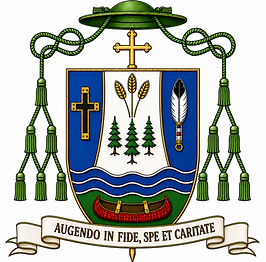
Galero (Ecclesiastical Hat)
The green ecclesiastical hat, called a galero, was originally a pilgrim's hat. A bishop's galero is distinguished by six green tassels on each side.
Processional Cross
The cross displayed behind the shield signifies the office of a bishop. An ordinary bishop bears a processional cross with a single horizontal bar, commonly known as a Latin cross.
Shield
The shield is the central element of every coat of arms and bears the symbols that identify its owner.
Colours
The blue fields represent the Blessed Virgin Mary and Saskatchewan, the Land of Living Skies.
Canoe
Long before Canada came into being, the canoe was the primary means of travel for many Indigenous Peoples. Later, it became essential to explorers, settlers, and missionaries. Canoeing in northern Saskatchewan was also a formative part of Bishop Ken's young adult years.
Eagle Feather
The Eagle Feather is sacred to First Nations and Métis Peoples. Because the eagle flies highest and sees farthest, the feather symbolizes wisdom and authority. On Bishop Ken's coat of arms, it also expresses his ongoing commitment to truth, reconciliation, and right relationship with Indigenous Peoples.
Cross
Bishop Ken is a member of the Missionary Oblates of Mary Immaculate, founded by St. Eugene de Mazenod. At perpetual profession, every Oblate receives a large missionary crucifix. In keeping with heraldic tradition, the cross is depicted without the corpus.
Trees and Wheat
Prince Albert is situated where the prairie meets the boreal forest. The wheat and pine trees represent the Diocese's agricultural and forestry heritage. Arranged in groups of three, they also symbolize the Holy Trinity.
Rivers
Two rivers flow through the coat of arms, representing the North and South Saskatchewan Rivers. They meet at The Forks, just east of Prince Albert, to form the Saskatchewan River, which flows to Lake Winnipeg and ultimately Hudson Bay. These rivers sustain communities, agriculture, wildlife, wetlands, and the boreal forest. They also recall the waters of Baptism and the common priesthood shared by all the baptized.
Motto
Bishop Ken's motto, Augendo in fide, spe et caritate, means Growing in faith, hope, and love. It is drawn from the Oblate Constitutions and Rules: "Growing in faith, hope, and love, we commit ourselves to be a leaven of the Beatitudes at the heart of the world." (Constitution 11)
Description du Blazon Mgr Ken Thorson, OMI
Galéro (Chapeau ecclésiastique)
Le chapeau ecclésiastique vert, appelé galéro, était à l'origine un chapeau de pèlerin. Le galéro d'un évêque se distingue par six glands verts de chaque côté.
Croix de procession La croix figurant derrière l'écu symbolise la charge épiscopale. Un évêque ordinaire porte une croix de procession à une seule traverse horizontale, communément appelée croix latine.
Shield L'écu est l'élément central de toute armoirie et porte les symboles qui identifient son propriétaire.
Couleurs Les champs bleus représentent la Bienheureuse Vierge Marie et la Saskatchewan, ses immenses ciels ouverts.
Canoë
Bien avant la création du Canada, le canoë était le principal moyen de transport pour de nombreux peuples autochtones. Plus tard, il devint indispensable aux explorateurs, aux colons et aux missionnaires. Les sorties en canoë dans le nord de la Saskatchewan ont également marqué la jeunesse de l'évêque Ken.
Plume d’aigle
La plume d'aigle est sacrée pour les Premières Nations et les Métis. Puisque l'aigle vole plus haut et voit plus loin, la plume symbolise la sagesse et l'autorité. Sur les armoiries de Mgr Ken, elle exprime également son engagement constant envers la vérité, la réconciliation et des relations justes avec les peuples autochtones.
Croix
Mgr Ken est membre des Oblats missionnaires de Marie Immaculée, fondés par saint Eugène de Mazenod. Lors de leur profession perpétuelle, chaque oblat reçoit un grand crucifix missionnaire. Conformément à la tradition héraldique, la croix est représentée sans le Christ.
Arbres et blé
Prince Albert est situé à la lisière de la prairie et de la forêt boréale. Le blé et les pins représentent le patrimoine agricole et forestier du diocèse. Disposés par groupes de trois, ils symbolisent également la Sainte Trinité.
Rivières
Deux rivières traversent les armoiries, représentant les rivières Saskatchewan Nord et Saskatchewan Sud. Elles se rejoignent à la fourche, juste à l'est de Prince Albert, pour former la rivière Saskatchewan, qui se jette dans le lac Winnipeg et, finalement, dans la baie d'Hudson. Ces rivières sont essentielles aux communautés, à l'agriculture, à la faune, aux milieux humides et à la forêt boréale.Elles évoquent aussi les eaux du baptême et le sacerdoce commun à tous les baptisé(e)s.
Devise
La devise de Mgr Ken, « Augendo in fide, spe et caritate », signifie « Croissant dans la foi, l'espérance et l’amour ». Elle est tirée des Constitutions et Règles des Oblats : « Croissant dans la foi, l'espérance et l’amour, nous engageons à être un ferment des Béatitudes au cœur du monde ». (Constitution 11)